Scattered data leaves you with no basis for a decision.
NEXTPAY weaves it into one, so AI can decide.
Data schema
Data schema
Data schema
Data schema
Understand Context
Deploy Agent
F&B agent

Peak-time prep
Stockout forecast
Weather-based suggestions
Customer win-back
Delivery agent

ETA-linked prep time
Order surge forecast
Rider pre-positioning
Delay risk detection
Logistic agent

Dispatch timing
Replenish before stockout
Retail agent

Empty-shelf detection
Display swap suggestions
Hourly staffing
Lastmile agent

Real-time rerouting
Early delay detection
Driver routing
Data schema
Data schema
Data schema
Data schema
Understand Context
Deploy Agent
F&B agent
Peak-time prep
Stockout forecast
Weather-based suggestions
Customer win-back
Delivery agent
ETA-linked prep time
Order surge forecast
Rider pre-positioning
Delay risk detection
Logistic agent
Dispatch timing
Replenish before stockout
Retail agent
Empty-shelf detection
Display swap suggestions
Hourly staffing
Lastmile agent
Real-time rerouting
Early delay detection
Driver routing
Data without connections is just records.
Raw data
Ontology data
Problems surface after the fact
Signals get read early, so you act first
Numbers pile up. People fill in the context
Data arrives with its business context built in
Every site gets the same generic model
Decisions speak the language of your domain
Collecting and interpreting falls on people
AI prepares the evidence. People just decide
It's hard to see why you got that result
Every decision traces back through the relations

01
Entities
Orders, items, shifts, places, devices. Everything in the field becomes an object with an identity, not a row in someone's spreadsheet.
02
Relationships
An order belongs to a site. A shelf holds an item. A shift covers the evening rush. Relationships turn separate records into one connected context.
03
Events and causality
Sales dip, weather turns, a delivery runs late. Events link causes to outcomes, so the model knows not just what happened, but why it happened.
What an ontology is
A working model of how your operation runs.
An ontology is a map of the things in an operation and the ways they relate: orders, items, shifts, places, machines, and the events that tie them together. It gives every record an identity and a place in the whole, so software can read the field the way an operator does.
01
Entities
Orders, items, shifts, places, devices. Everything in the field becomes an object with an identity, not a row in someone's spreadsheet.
02
Relationships
An order belongs to a site. A shelf holds an item. A shift covers the evening rush. Relationships turn separate records into one connected context.
03
Events and causality
Sales dip, weather turns, a delivery runs late. Events link causes to outcomes, so the model knows not just what happened, but why it happened.
On this structure, AI stops guessing from fragments and starts reasoning over your operation. And this map is not a diagram on a wall. We built it as a live semantic layer that every system can query. Ours has a name: StoreGraph.
The Ontology is the map. This layer runs it.
Every decision starts with StoreGraph.A semantic layer that gives scattered datarelationships. AI Hub reads it and makesthe call, so people only decide what matters.
Every decision starts with StoreGraph. A semantic layer that gives scattered data relationships.
AI Hub reads it and makes the call, so people only decide what matters.
StoreGraph is not a database.
It's a semantic layer. BigQuery, Elasticsearch, Graph Store, MySQL, Redis, and the event bus, one shared ID, one set of relationships, one context AI can read.
Agents never touch a datastore.
They call the StoreGraph API. It controls the ID, the permission, the evidence, the freshness, and the confidence before any agent sees a single row.
It's a semantic layer. BigQuery, Elasticsearch, Graph Store, MySQL, Redis, and the event bus, one shared ID, one set of relationships, one context AI can read.
They call the StoreGraph API. It controls the ID, the permission, the evidence, the freshness, and the confidence before any agent sees a single row.
When data connects,AI can decide.
Contextual
Scattered operational data, connected. Orders, inventory, payments, logistics, once separate streams, come together in one graph (StoreGraph), and AI reads your whole operation as a single context.
Actionable
Scalable
When data connects, AI can decide.
Contextual
Contextual
Scattered operational data, connected. Orders, inventory, payments, logistics, once separate streams, come together in one graph (StoreGraph), and AI reads your whole operation as a single context.
Actionable
Actionable
Data becomes decisions and actions. Logic, action, and security are encoded alongside the data in one engine, so the work doesn't stop at analysis. It carries through to what AI agents do.
Scalable
Scalable
A single Ontology extends to a different agent for every industry. The structure stays put. Only the entities and relationships change to speak each field's language, so the same way of deciding stands in new domains.
Not a search engine.
A Decision Intelligence layer.
It started as retrieval over your data. On top of it sit the shared graph, the agents, the actions, and the outcomes. That is Decision Intelligence: it doesn't stop at an answer but runs the operation and learns from what it did.
Not a search engine. A Decision Intelligence layer.
It started as retrieval over your data. On top of it sit the shared graph, the agents, the actions, and the outcomes. That is Decision Intelligence: it doesn't stop at an answer but runs the operation and learns from what it did.

A single Ontology,
different agents by industry
One backbone, different judgment at every site.
It reads each industry's data and makes the calls each site needs.
Industry data




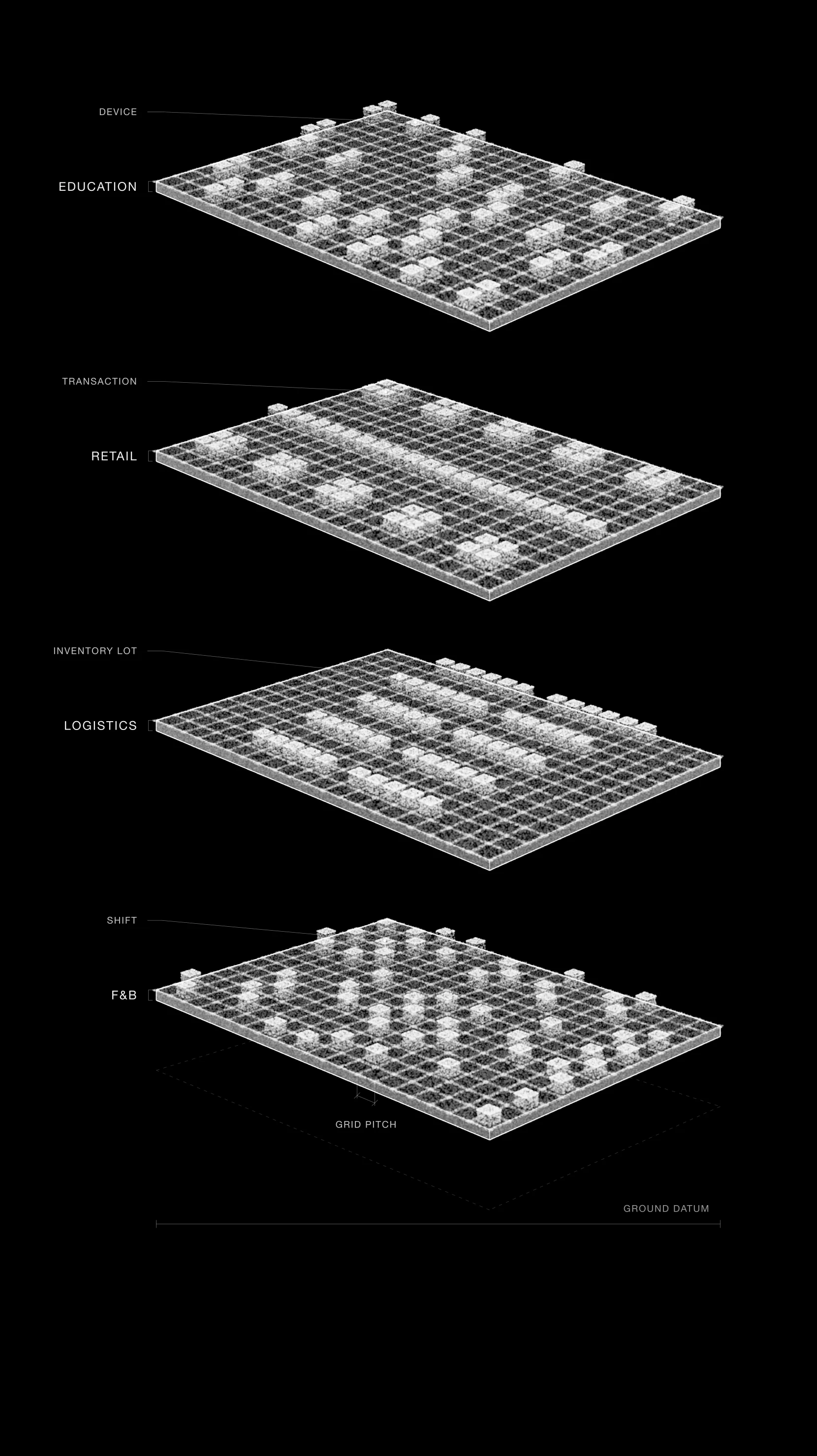
Ontology

F&B agent
Peak-time prep
Stockout forecast
Weather-based suggestions
Customer win-back
Delivery agent
ETA-linked prep time
Order surge forecast
Rider pre-positioning
Delay risk detection
Logistic agent
Dispatch timing
Replenish before stockout
Retail agent
Empty-shelf detection
Display swap suggestions
Hourly staffing
Lastmile agent
Real-time rerouting
Early delay detection
Driver routing
Execute in realtime
Action 01
Action 02
Action 03
One thread
Ontology gives the field a language.StoreGraph makes it one shared layer.Agents read it and run the loop.
A model of your operation, a semantic layer every system speaks, and industry agents that turn it into decisions on site. One thread, end to end.
Traceable by relationship
The reasoning behind every decision stays in the relationships.
From observation to outcome, every stage is linked as a relationship, so you can trace why a decision was made and what actually worked.
01
Observation
what happened on site
02
Signal
a change worth noting
03
Forecast
what comes next
04
Prescription
what to do
05
Approval
the choice a person made
06
Execution
the action taken
07
Outcome
what changed
08
Relearning
feeds the next decision









The unit changes.The language doesn't.
A site's scattered records become one context it can act on today.
One thread
Ontology gives the field a language. StoreGraph makes it one shared layer. Agents read it and run the loop.
A model of your operation, a semantic layer every system speaks, and industry agents that turn it into decisions on site. One thread, end to end.
Traceable by relationship
The reasoning behind every decision stays in the relationships.
From observation to outcome, every stage is linked as a relationship, so you can trace why a decision was made and what actually worked.
01
Observation
what happened on site
02
Signal
a change worth noting
03
Forecast
what comes next
04
Prescription
what to do
05
Approval
the choice a person made
06
Execution
the action taken
07
Outcome
what changed
08
Relearning
feeds the next decision
01
Observation
what happened on site
02
Signal
a change worth noting
03
Forecast
what comes next
04
Prescription
what to do
05
Approval
the choice a person made
06
Execution
the action taken
07
Outcome
what changed
08
Relearning
feeds the next decision
The unit changes. The language doesn't.
A site's scattered records become one context it can act on today.
Ontology that understands the domain,
working with people on every decision
Learn more
 +2
+2 +3
+3 +1
+1 +2Ordered
Covers / 15 min
45
48
24
0
13:35
14:05
14:32
Kitchen load by hour
Hall A
32
16
0
11
13
15
17
19
21
Seats filled
39
Table
Menu
Status
#A-1043
Table 07 · 4 seats
#A-1047
Table 05 · 6 seats
#A-1052
Table 09 · 6 seats
#A-1055
Table 12 · 2 seats
#A-1058
Table 03 · 4 seats
#A-1064
Table 11 · 4 seats
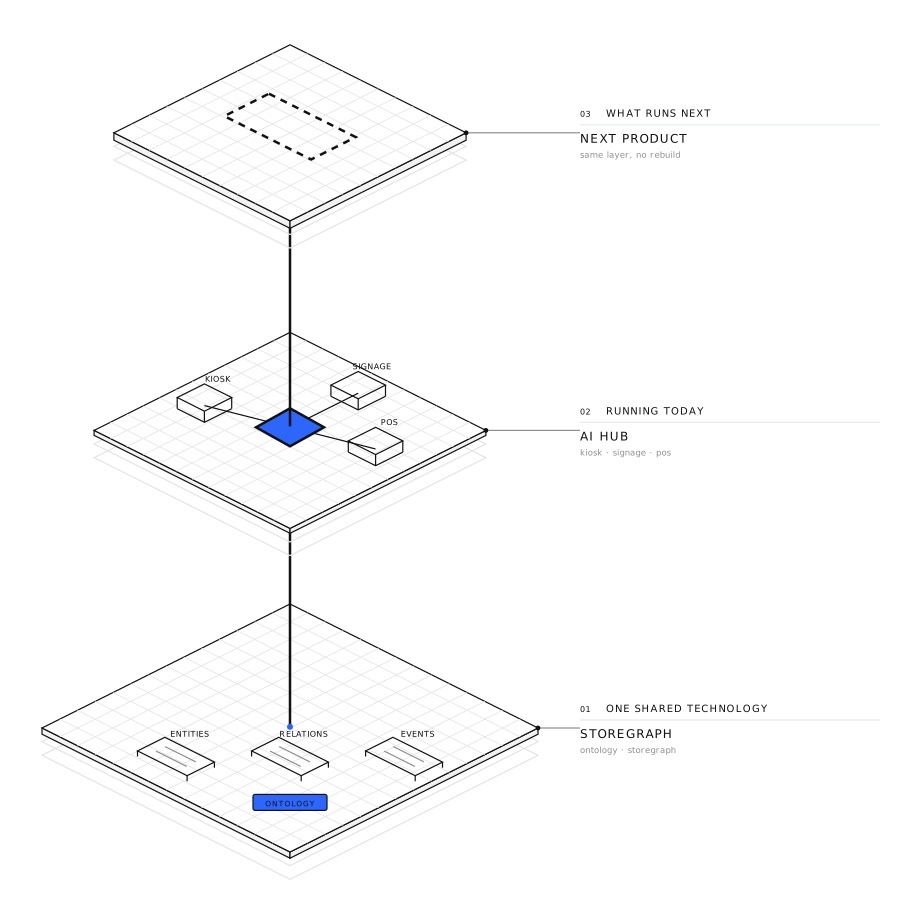
One technology. Many products.
Ontology doesn't change. StoreGraph is what we call ours. AI Hub is what it runs today, and whatever runs next sits on the same layer.

Make every call in
your workspace smarter
Every field runs differently.
Talk to our experts about
what your operation actually needs.